Author: Karen Mongey
Karen Mongey is a registered Australian Patent and Trade Mark Attorney. She holds a PhD in Chemistry from Dublin City University, and a Master of Industrial Property from the University of Technology, Sydney. Karen has worked in intellectual property prosecution and management for a number of years, and has been providing advice to the Australian Museum since 2006.
This chapter benefited from the extensive comments from Adam Flynn, Senior Legal Officer, National Film and Sound Archive.
INTRODUCTION
As consumerism grows, it is evident that visitors to the cultural and arts sector are not immune to this trend. They often wish not only to immerse themselves temporarily in the subject matter, exhibition or event, but also to have a take-home physical reminder of it. As a result, many museums and galleries find themselves in the business of creating tangible products in the form of mementos sold to visitors for the purpose of generating revenue to the institution. This is increasingly viewed as an extension of the public outreach and exhibition mandate of museums and galleries.
In this context, where collecting institutions create, manufacture and distribute products that are tied to the service they provide, design law becomes relevant. While perhaps not as fundamental to the activities of collecting organisations as copyright (discussed in Chapter 26), the principles of design law are becoming more important for the staff of collecting institutions. As an example, a museum may decide to leverage an exhibition of designer chairs by creating key-rings of the chairs to be sold as momenta in the museum shop. The reproduction of a collection item in such a manner can not only raise the risk of infringing design rights, but also copyright and moral rights – or all of them. The intellectual property issues surrounding this example, and others like it, form the subject matter of this chapter.
A design refers to the overall appearance of a product resulting from one or more visual features of a product.[1] Design registration protects the visual features of products, including the shape configuration, pattern and ornamentation, which, when applied to a product, give it a unique visual appearance. It protects the look and the shape of the object.
Design registration and protection is immediately relevant for a wide range of material that may feature in the collections of such museums as the Powerhouse Museum in Sydney. This museum’s diverse collection spans, among other things, technology, design, industrial and decorative arts. This particular museum ‘engages with contemporary technologies to showcase Australian innovation in the creative industries, developments in science and ecologically sustainable technologies’ [2] and provides for an interesting case study in which issues of design law may arise.[3] Examples of collection objects that may qualify for design protection include fashion items, designer furniture, and designs of cultural significance. Furthermore, institutions may commission, or its staff may create, designs worthy of registration and protection under this intellectual property regime, for example, an exhibition design showcase or a packing case for travelling objects.
Unfortunately, it is often not a simple matter to identify which intellectual property regime (design, copyright or both) is appropriate to the reproduction of a given collection item, particularly where that item could be described as being inherently an industrial design. Perhaps the most daunting intellectual property area for institutions with contemporary collections akin to that of the Powerhouse Museum is that in which a collection item may be protected under both design and copyright intellectual property law. This area of law is commonly referred to as the overlap between design and copyright. Examples of collection material that may fall within the realm of this intricate area of law include modern pieces of design furniture, fashion items and objects of decorative arts such as modern pottery and precious ceramics.[4]
This chapter seeks to outline and identify issues in order to assist galleries, museums and libraries to avert potential problems in the reproduction of objects in their collections that are protected designs (and to identify those that are not protected and therefore may be reproduced). In the first part of this chapter, an overview of Australian design law is given, with reference to material that may be protected under design law and displayed and held in collections of galleries and museums. The intellectual property issues facing these institutions as they move towards adopting initiatives to provide unprecedented access to this collection material by both real and virtual avenues is discussed. In the later part of the chapter, the design and copyright overlap is discussed, focusing on its impact on various merchandising and exhibition activities.
DESIGN LAW
What is protected under design law?
Design law can protect the visual features of products, whether these features are two-dimensional (such as patterns applied to the surface of a product, for example shirt fabric design) or three-dimensional (such as the shape or form of the product, for example furniture design) if certain conditions of novelty and distinctiveness are met. How the product operates is not protected by design law, although such mechanics may be suited to protection under patent law.
Under the Designs Act 2003 (Cth), a ‘design’ is defined in relation to a product as ‘the overall appearance of the product resulting from one or more visual features of the product’. ‘Product’ is defined in Section 6 of the Act as a ‘thing that is manufactured or handmade’ [5], while the term ‘visual feature’ includes ‘the shape, configuration, pattern and ornamentation of the product’.[6] It is not compulsory for a visual feature to serve a functional purpose.
That said, a product must have some function of utility other than that of merely carrying the design. So a design printed on the cover of a book has not been applied to a ‘product’ for the purposes of the Act. In contrast, designs printed on wallpaper are considered to have been ‘applied’, because the wallpaper is a product of manufacture that has a functional purpose as wall decoration.[7]
What protection is conferred under design registration?
By registering a design under the Designs Act 2003 (Cth), the registered owner gets a monopoly over the design.[8] The registered owner acquires the exclusive right to apply the registered design to a product, or use such a product, in any way for the purposes of any trade or business. These rights are personal property and are capable of assignment and of devolution by will or operation of law.[9]
Duration of rights
The term of protection for a registered design is a maximum of ten (10) years from the filing date, comprising an initial term of five (5) years, with the possibility of a further five (5) years if the registration is renewed.[10]
Features required for registration
A design can be registered in Australia provided that it is both ‘new’ and ‘distinctive’.[11]
1. NEW
The criterion of new can be satisfied if the design is not identical to any design previously published anywhere in the world, nor any design previously used publicly in Australia, prior to the date on which the design application was made.[12] A design is considered to be published if it appears on the Internet.
2. DISTINCTIVE
The criterion of distinctive is satisfied unless the design is substantially similar in overall impression to another design, with more weight to be given to the similarities between the designs than to their differences.[13]
It is perhaps basic to the concept of a design that it gives individuality to the product to which it is applied – and that this can be judged visually. There must be sufficient individuality of appearance to distinguish the article/product from its ‘fundamental form’. Features of a design that do no more than convey the idea of a general shape appropriate to a function that the product is intended to perform and that are consistent with a variety of particular shapes in products copying those features, cannot be protected under the Designs Act 2003 (Cth).
Registration and administration
To obtain protection the design must be registered by applying to the Designs Office at the federal government agency, IP Australia.[14] Australian registered designs are administered by IP Australia, and the process is initiated when the owner submits a design application to IP Australia (including representation(s) of the design and the prescribed application fee). IP Australia then issues a design application number, and a filing date is established from which the applicant has a six month period to request the design to be registered or published.
IP Australia maintains a database of designs registered under the Designs Act 2003 (Cth) and information on these designs can be accessed by the public via the Australian Designs Data Searching (ADDS) system.[15] Examples of registered designs can be found on the IP Australia website.[16] The ADDS system allows the public to search applications for design registration and registered designs, via a wide range of data fields. The search functionality allows searching on names of applicants or owners, lodgement and registration information, article or product in respect of which the design is registered, date of registration and International Design Classification.
Enforcement
Publication will prevent others from registering the design, but does not confer any rights itself. Registration gives the owner the right to use, sell or license that design for a maximum of ten years. After that time, design protection no longer applies. For a design owner to enforce a design registration in Australia, the design must first be successfully examined and certified by IP Australia. Design registration is jurisdictional and an Australian registered design will only be afforded protection within Australia.
For the duration of the registered design period, it is an infringement of the exclusive rights of the registered design owner to:
- make a product that embodies the design;
- import, sell, hire or dispose of a product that embodies the design; and
- authorise another person to do any of these things.
Dealing with collection items protected by design registration in Australia
Where museums and galleries hold objects in their collections that are protected by current Australian design registrations belonging to a third party, care should be taken to avoid infringement of the design owner’s rights. It is worth noting that there are no ‘exceptions’ contained within the Designs Act 2003 (Cth) specifically relevant to collecting institutions.[17] You may be breaching the rights of the design rights owner even though you are genuinely acting in the interests of the collection or the object.
1. IS PERMISSION REQUIRED TO EXHIBIT A COLLECTION ITEM THAT IS PROTECTED BY A CURRENT DESIGN REGISTRATION IN AUSTRALIA?
Neither acquiring a collection item that is protected by a current Australian design registration nor exhibiting it is likely to constitute an infringement under the Designs Act 2003 (Cth).[18] If staff are concerned, it would be wise to consult any conditions of sale attached to such a product. However, it is unlikely that the display of the article would be considered ‘use for the purposes of any trade or business’.[19]
Generally, the curator will ensure that the designer is credited. This is particularly important where it is unclear whether copyright protection subsists in the object in addition to any design rights. Where there is a copyright/design overlap, the moral rights obligations provided under the Copyright Act 1968 will apply. This is discussed in more detail later in this chapter.
2. IS PERMISSION REQUIRED TO PRODUCE, AND OFFER FOR SALE, THREE-DIMENSIONAL REPLICAS OF A COLLECTION ITEM THAT IS CURRENTLY PROTECTED BY DESIGN REGISTRATION?
Whether it is for a public collection or not, a person infringes a registered design when the person makes, sells, hires or imports a product, or uses for business or trade, a product that embodies the design, or a design that is substantially similar to it.[20] The production and offer for sale of replicas (life-size or miniature) of a collection item protected by a current design registration, without the express permission or licence of the registered owner, is likely to be an infringement of the registered design, because a replica is a product (for example a key-ring) that is either identical or substantially similar in overall appearance to the protected item. This could potentially lead to legal action, resulting not only in costs, damages and loss of revenue but also unwanted public embarrassment.
Where design registration has expired, the collecting institution is free to replicate the collection item. When the term of the design registration expires, not only does the design protection cease; the designer is prohibited from invoking copyright to protect against products that would have otherwise infringed. That said, care should be taken to ensure that the public is not misled to believe that the replicas are endorsed by (or originate from) the designer, as this could lead to a legal action of passing off against the collecting institution.[21]
THE OVERLAP BETWEEN DESIGN AND COPYRIGHT PROTECTION
Before commencing on this section of the overlapping of the provisions of the Designs Act 2003 (Cth) and the Copyright Act 1968 (Cth), it is useful to reiterate the object of each piece of legislation separately, and to acknowledge the significant differences in the nature and intended scope of protection that each system provides.
The intended objects of design and copyright law
The objective of design law is to protect the visual features of products,
• having an industrial or commercial use,
• where multiple copies are to be made.
This is often referred to as the ‘industrial application’ of the design. In effect, design law protects the visual appearance of manufactured products under a registered system, with exclusive exploitation rights lasting for a period of up to ten years. Unlike copyright protection, design protection is not automatic, and the object of registration is to entitle the industrial designer to protect the design against the unfair competition of free copying for the ten-year term.
In contrast, the object of copyright is to automatically assign a set of exclusive rights to original material that fall within the two broad categories mentioned earlier in this book (‘works’ and ‘subject matter other than works’)[22] for the purposes of protecting the creator’s skill, labour and judgement involved in its production (as opposed to any creative merit)[23] upon creation. The term of copyright protection varies according to the type of material under consideration. However, duration of copyright is in general substantially longer than the maximum ten-year term afforded by registered design protection.[24]
As covered in Chapter 26, copyright risks are considerable for a cultural institution in its dealings with collection items, including when reproducing them in photographs or as replicas. However, where a collection object (which may in itself be an industrial design) is being used to create another product, it is design rights that usually need close consideration.
How does the overlap happen?
Under certain circumstances, material that qualifies for copyright protection may also be eligible for design registration. It can often be problematic to categorise with certainty a work as inherently artistic and thus protected by copyright, or as an industrial design, and therefore more appropriately protected under design law. In a well-presented essay on the subject, Ian McDonald (formerly of the Copyright Council of Australia) has succinctly summed up the conundrum as follows:
Motorcycle parts belong firmly in designs law; a John Coburn painting belongs firmly in copyright law; industrial moulds belong firmly in designs law; a Robert Klippel sculpture belongs firmly in copyright law, albeit they often incorporate industrial items. But the difficulty is in the middle area – in relation to applied design which has some sort of artistic integrity, rather than a merely utilitarian design – where should the legislation draw the line with a Philip Starck coathanger; or a BANG design table?[25]
Furthermore, the possibility of dual protection under both copyright and design law arises because the rights of a copyright owner in a two-dimensional ‘artistic work’ include the right to reproduce the work in a three-dimensional form. An ‘artistic work’ is deemed to have been reproduced if a two-dimensional work is produced in three-dimensional form or if a three-dimensional work is produced in two-dimensional form.[26] As a result, copyright protects potentially all commercial and industrial products that originate as drawings (such as engineering drawings or plans).
Dual protection under intellectual property regimes is generally viewed in a negative light. As a matter of policy, it is considered that the extended period of copyright protection in the industrial property domain, compared with the ten-year term of protection provided by design registration, would cause serious problems of uncertainty and indeed unfairness.[27]
How does the overlap affect collecting organisations?
This tricky area of law in which design protection bleeds into copyright protection is particularly relevant for collecting institutions wishing to reproduce an object which may be considered a ‘design’ (for the purposes of the Designs Act 2003 (Cth)) and/or an ‘artistic work’ (for the purposes of the Copyright Act 1968 (Cth)).[28] Collecting organisations are increasingly required to make an informed decision as to whether such an object is protected under copyright or design law (or both) prior to any reproduction.
For example, what of Verner Panton’s classic ‘Panton Chair’ which has won various design prizes worldwide and graces the collections of numerous renowned museums – is it a design or a work of art?[29] Or Castiglioni’s iconic ‘Arco Lamp’ designed in 1962, and which can be found in the permanent design collection of a number of prestigious museums? The question is which form of intellectual property protection needs to be considered before reproducing such an object in either three-dimensional or two-dimensional form – design, copyright or both?
While the overlap provisions contained in the relevant statues limit the protection available for designs in this overlapping area, there are incidents in which dual protection (copyright and design protection) is possible. The following synopsis provides a general guide to the key legal principles of the overlap chiefly relevant to collecting organisations.[30] Some hypothetical examples encountered by collecting organisations follow this discussion, with a view to bringing to life the academic concepts and providing a practical meaning.
1. CIRCUMSTANCES IN WHICH COPYRIGHT AND DESIGN PROTECTION OF A COLLECTION OBJECT MAY BE LOST.
The Copyright Act 1968 (Cth) contains provisions that limit the copyright protection for designs (artistic works) that are mass-produced in a three-dimensional version.[31] The following incidents in which copyright protection of an artistic work embodied in a design may be lost (unless dual protection is possible) are of importance to collecting organisations.
• Once a design is registered under the Designs Act 2003 (Cth), only design rights apply when considering reproduction of the design.[32] That is, copyright protection is lost, unless dual protection is possible (see 2 below).
• Where a design application has not been made, copyright protection of the artistic work may be lost where the design is industrially applied and commercially exploited.[33] This is the case unless the work is one of artistic craftsmanship (discussed in 3 below), in which case copyright will still be enforceable.[34] Industrial application generally occurs where a design is applied to more than fifty articles.[35] However, this is not a hard and fast rule and depends on the circumstances, and industrial application can also occur when smaller numbers of articles have been produced.[36]
2. CIRCUMSTANCES IN WHICH A COLLECTION OBJECT MAY BE PROTECTED UNDER BOTH COPYRIGHT AND DESIGN LAW (DUAL PROTECTION)
Some collection objects may be eligible for copyright protection and simultaneously registered as a design. There may be dual protection. In particular, a registered design of a two-dimensional pattern or ornamentation that results in the reproduction of an artistic work when applied to the surface of an article retains copyright in the ‘artistic work’ and enjoys dual protection. For example, a painting screen-printed on a T-shirt or applied to a mug. Where collection objects fall in this category, copyright may coexist with any registered design rights. Where unauthorised reproductions are made, infringement actions may be taken against the collecting institution in respect of either or both rights.
3. WORKS OF ARTISTIC CRAFTSMANSHIP
As mentioned above, a ‘work of artistic craftsmanship’ which is ‘industrially applied’ retains copyright protection.[37] Neither the Copyright Act 1968 (Cth) nor the Designs Act 2003 (Cth) contains any definition of what constitutes a work of artistic craftsmanship. Furthermore, no precise definition of the term has been agreed upon by case law. So whether an object falls within the scope of this definition is subject to the interpretation of the collecting institution. Due to the difficulties arising from the interpretation of this phrase, it is often unclear whether an object falls into this category. Generally, the greater the need for a design to satisfy the need for functional or utilitarian requirements, the less likely it will be considered a work or artistic craftsmanship.
The following bullet points serve as guidelines to assist collecting organisations in deciding whether an object falls within the scope of this category.[38]
• To be considered a work of artistic craftsmanship, the object must be of artistic quality and involve craftsmanship.[39]
• To possess artistic quality, the object need not be one of fine art but must have more than mere visual appeal.
• ‘Craftsmanship’ does not necessarily require that the object is handmade.
• There must ‘be real and substantial artistic effort’ which is not constrained by ‘utilitarian considerations’.[40] Where functional characteristics of the object can be deemed to constrain the aesthetics of the object, the object is less likely to be considered a work of artistic craftsmanship. That said, the object can be functional, such as a chair or a lamp.
• A critical and deciding factor is the original intention of the artist in creating the work;[41] when designing the object, did the designer have any intention of creating a work of artistic craftsmanship?
In an attempt to determine which category of intellectual property is relevant to the reproduction of an object, curators and staff may find difficult situation of dissecting the aesthetic aspect from the utilitarian function of the collection item. By assessing the nature of the collection item, they may be inadvertently called upon to define art – a conundrum that surely does not form the part of the job description of even the bravest curator.
PRACTICAL EXAMPLES ENCOUNTERED BY COLLECTING INSTITUTIONS
So where does this difficult area of intellectual property legislation leave us? What are the practical implications for staff in collecting institutions wanting to market and leverage items of industrial design within their collections?[42] While products commercially exploited as three-dimensional industrial designs will generally be denied copyright protection with respect to three-dimensional reproductions, other copyright reproduction rights may still subsist. What about photography of a registered design – could this potentially infringe copyright of the designer? Is permission required to include images of a three-dimensional collection item that is currently protected by design registration in Australia in museum brochures, exhibition material and in online publicly accessible databases?
These questions are explored further in relation to a number of practical examples. However, in view of the legal complexity of the design and copyright overlap, the following practical examples are provided to staff of collecting institutions as a guide only, and provide an indication as to when to seek legal advice.
Example 1: Museum X purchases a stylish hand-crafted chair made by Y based upon an innovative design by Y. Museum X wishes to form miniature replicas of the chair for sale in the Museum shop.
When considering whether to reproduce, in three-dimensional form, an object that forms part of a contemporary collection, a series of questions that consider the relevant intellectual property regimes (copyright and design) needs to be addressed by staff. A decision tree is given below with respect to this example.
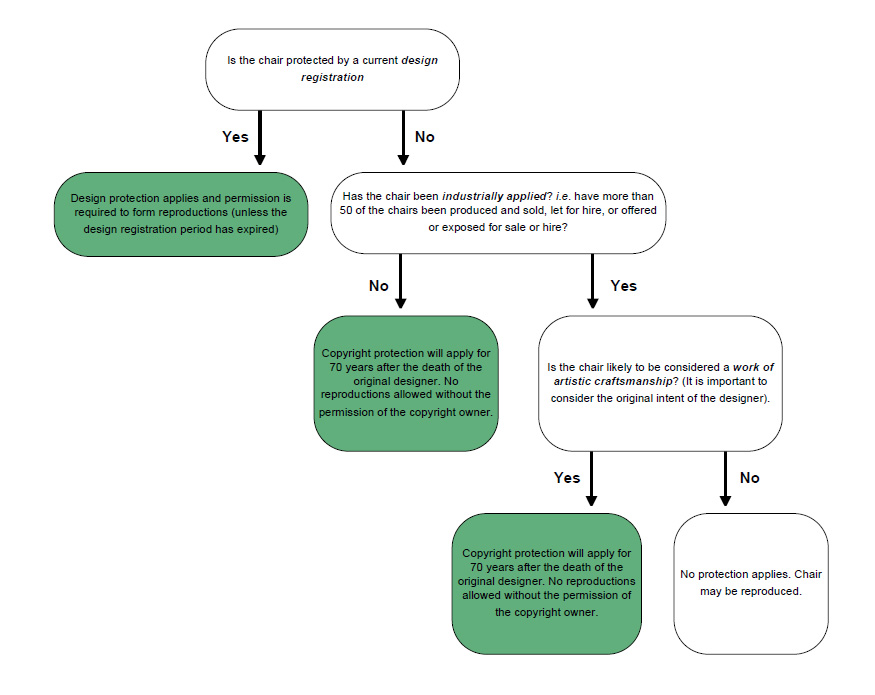
The answers to the questions posed above depend on the particulars of the chair (object) in question and the surrounding facts. While collecting organisations may opt to decide themselves whether an object falls within the definition of a ‘work of artistic craftsmanship’, or whether ‘industrial application’ of the design has occurred, it should be noted that uncertainties will arise from the interpretation of these phrases. The guidelines given earlier in the chapter may be followed. However, a direct answer cannot be given here, other than to say that the potential for infringement by Museum X of Y’s rights exists.
Where it is decided that the chair is protected by copyright (the chair is considered a work of artistic craftsmanship), the moral rights of the designer will need to be respected. These are discussed in detail in the previous chapter. In the example above, the chair should not be modified in any way without permission of the designer, and the designer should be attributed. [43] Where it is decided that the chair was protected by a design registration that has since expired, care would still need to be taken to avoid any claims of passing off by the designer. That is, it should be made clear that the replicas originate from the collecting organisation and not the designer.[44]
Example 2: Museum A purchases a chic modern floor lamp that it considers a work of art from Designer B. Museum A wishes to include images of the lamp in a book that will be used to advertise Museum A’s collection.
In this example, it is clear to Museum A from the onset that they are dealing with a work of artistic craftsmanship, and following the decision tree given in Example 1 is not required. It is immediately evident that Designer B can enforce copyright with respect to the use of his or her lamp and any reproductions of it. It would be advisable for Museum A to negotiate with Designer B and to obtain a license with respect to use of images of the lamp (discussed in more detail in Chapter 26). This would be best done at the time of purchasing the lamp from the designer. On exhibiting the lamp, Museum A must observe the moral rights of Designer B.
Example 3: Gallery Z purchases one-off fashion garments, costumes and jewellery pieces (‘the material’) by Designer A. Gallery Z wishes to exhibit the material and include photographs of the material in its merchandising leaflets. Gallery Z is also considering making and selling reproductions of the material in the Gallery shop.
Purely two-dimensional designs (such as the drawings on fashion garments) have the ability of dual copyright and design protection. Where products reproduce the pattern or ornamentation of a design, care should be paid to existence of copyright and design overlap, where there is a risk of infringing design rights and copyright in these visual features.[45]
In this example, it is unlikely that Designer A will have considered design registration. It is likely however, that the material is protected by copyright, all being ‘works of artistic craftsmanship’. Gallery Z would have to consider carefully its use of these collection items, attributing Designer A in their exhibition (that is, to respect the moral rights of the designer), and negotiating reproduction rights of the material for any gallery merchandising material.
CONCLUSION
The area of design law, and in particular the legislative framework which has been drafted to control the interface between design and copyright protection, is complicated. Clearly, the issues and considerations that any particular museum or gallery may face with respect to design law will depend greatly on the nature of the material held within its collection as well as the material presented in its exhibitions and programs, and whether this material is also protected under copyright law. Issues of design law and design or copyright overlap may arise in areas as diverse as collection management, exhibitions, merchandising, public education programs, publications and websites.
Collecting institutions should not rely on specific examples given in this chapter for use of its collection material, but should get specific advice for their particular situation. Since this is clearly a difficult legal area which is subject to interpretation, it would be advisable for collecting organisations to proceed with any reproductions with caution. With respect to potential infringements perhaps the old adage ‘prevention is better than cure’ rings very true. If in doubt, and in particular where the reproduction is to be used in a publicly accessible environment (for example, shop) for either profit to the collecting institution or otherwise – consult all paperwork received with the object, ask permission of the designer, seek a licensing arrangement where appropriate or seek further legal advice. This is of course of particular importance prior to any merchandising ventures that may later see the institution in muddy water.
For further information, see the references given in the section below.
CONTACTS FOR DESIGN LAW IN AUSTRALIA AND FURTHER READING
1. IP Australia www.ipaustralia.gov.au/.
2. Copyright Council of Australia www.copyright.org.au/.
3. Intellectual Property, Third Edition, Anne Fitzgerald and Dimitios G Elidaes, Lawbook Co., 2008.
4. Arts Law Centre of Australia – http://www.artslaw.com.au/.
5. Intellectual Property: Text and Essential Cases, Third Edition, Rocque Reynolds and Natalie Stoianoff, The Federation Press, 2008.
6. ‘WIPO Guide on Managing Intellectual Property for Museums’ available at http://www.wipo.int/copyright/en/museums_ip/.
ENDNOTES
[1] Designs Act 2003 (Cth) at s 5.
[2] http://www.powerhousemuseum.com/about/index.asp
[3] The discussion in this chapter is based on Australian law. Design law, and also that of copyright, in other countries may be similar in many respects, but there are aspects of law, discussed in this chapter, that do not apply in other countries.
[4] Some practical museum and gallery examples are dealt with later in this chapter.
[5] Section 6 of the Designs Act 2003 (Cth) defines a product as follows –
(1) For the purposes of this Act, a thing that is manufactured or hand made is a product (but see subsections (2), (3) and (4)).
(2) A component part of a complex product may be a product for the purposes of this Act, if it is made separately from the product.
(3) A thing that has one or more indefinite dimensions is only a product for the purposes of this Act if any one or more of the following applies to the thing:
(a) a cross section taken across any indefinite dimension is fixed or varies according to a regular pattern;
(b) all the dimensions remain in proportion;
(c) the cross sectional shape remains the same throughout, whether or not the dimensions of that shape vary according to a ratio or series of ratios;
(d) it has a pattern or ornamentation that repeats itself.
(4) A kit which, when assembled, is a particular product is taken to be that product.
[6] Section 7 of the Designs Act 2003 (Cth) defines visual feature as follows:
(1) In this Act: ‘visual feature’, in relation to a product, includes the shape, configuration, pattern and ornamentation of the product.
(2) A visual feature may, but need not, serve a functional purpose.
(3) The following are not visual features of a product:
(a) the feel of the product;
(b) the materials used in the product;
(c) in the case of a product that has one or more indefinite dimensions:
(i) the indefinite dimension; and
(ii) if the product also has a pattern that repeats itself – more than one repeat of the pattern.
[7] Designs Act 2003 (Cth) at s 6.
[8] Note that protection under the Copyright Act 1968 (Cth), which arises automatically once an original idea is put in a material form, does not require registration. In contrast, protection under the Designs Act 2003 (Cth) and the Patents Act 1990 (Cth) is obtained through registration.
[9] Designs Act 2003 (Cth) at s 10. For example, they may be used as security for loans and may be seized and disposed of by creditors or liquidators. They are assets.
[10] Designs Act 2003 (Cth) at ss 46, 47.
[11] Designs Act 2003 (Cth) at s 15(1).
[12] Designs Act 2003 (Cth) at s 15(2). More formally, a design is considered new provided it is not identical to a design that forms part of the prior art base as it existed before the design’s priority date.
[13] Designs Act 2003 (Cth) at s 19(1).
[14] www.ipaustralia.gov.au/.
[15] http://www.ipaustralia.gov.au/designs/.
[16] http://www.ipaustralia.gov.au/designs/ex_jug.shtml
[17] Unlike the Copyright Act 1968 (Cth) dealt with in Chapter 26, which contains provisions allowing staff of collecting institutions to reproduce and communicate copyright material for certain purposes.
[18] Of course curators should ensure that the collection item was acquired through the appropriate legal channels. This may include research into the provenance of the object.
[19] Designs Act 2003 (Cth) at s 71.
[20] During the life span of a design registration, its owner can prevent others from making or dealing with products having an identical or substantially similar overall impression to the registered design. Designs Act 2003 (Cth) at s 71(1).
[21] The law of passing off prevents one person from misrepresenting his or her goods or services as being the goods and services of another, or having some association or connection with the goods or service of another when this is not the case.
[22] Copyright law protects the material form in which ideas or information are expressed, being original ‘works’ and ‘subject matter other than works’, and copyright protection is automatic once the criteria set out in the Copyright Act 1968 (Cth) are met. ‘Work’ is defined in s 10(1) as meaning ‘a literary, dramatic, musical or artistic work’. ‘Subject matter other than works’ is not defined under the Act, but is taken to mean sound recordings, films, published editions, and sound and television broadcasts.
[23] Sands & McDougall Pty Ltd v Robinson (1917) 23 CLR 49.
[24] For example, copyright in an ‘artistic work’ lasts for 70 years from the end of the calendar year in which the author died.
[25] Ian McDonald, The Overlap between Design and Copyright Law, http://www.lapres.net/deslaw.html.
[26] Copyright Act 1968 (Cth) at s 21(3).
Due to the relatively lengthy time span of the protection relative to that
[27] afforded to a regular ‘design’; Designs Law Review Committee, Report on the Law Relating to Designs, Government Printer, Canberra, 1973, paras 251–62.
[28] Another key area, although perhaps not so relevant for collecting organisations, in which the overlap commonly occurs is where drawings for the basis of a mass-produced industrial product. This is because a three-dimensional representation of a two-dimensional work amounts to reproduction of that work under the Copyright Act 1968 (Cth) s 21(3).
[29] One of the first models belongs to the Museum of Modern Art in New York.
[30] Rather than a complete breakdown of all of the legal issues, which falls outside the scope of this chapter.
[31] The copyright/design overlap provisions, specifically ss 74–7 of the Copyright Act 1968 (Cth), define the copyright protection available to articles which could potentially be registered as designs under the Designs Act 2003 (Cth).
[32] Copyright protection is lost from the date on which the application is filed.
[33] That is, where such products that apply the design are sold, let for hire or offered for sale or hire.
[34] Acording to s 77 of the Copyright Act 1968 (Cth). This section does not operate where the artistic work which corresponds to the designs is a ‘work of artistic craftsmanship’, a building or a model of a building (s 77(1)(a)) or where the corresponding design is among the designs excluded from registration under Designs Regulations 2004 (Cth), Reg 4.06.
[35] Or to one or more articles manufactured in lengths or pieces. Copyright Regulations 1969 (Cth) 1969 Reg 17.
[36] Safe Sport Australia Pty Ltd v Puma Australia Pty Ltd (1985) 4 IPR 20.
[37] Unless it has been registered as a design.
[38] The category of being a work of artistic craftsmanship.
[39] A sculpture to also be considered as a work of artistic craftsmanship.
[40] The more substantial the requirement to satisfy a functional consideration, the less the scope is for determining the work to be one of artistic craftsmanship.
[41] Burge v Swarbrick [2007] HCA 17; (2007) 234 ALR 204; 81 ALJR 950 (26 April 2007).
[42] It is worth noting at this point, that a guide has been developed by the World Intellectual Property Organization (WIPO) for museums, and the broader cultural heritage community, to help them use the intellectual property system to improve the management of their collections in the digital environment. The WIPO Guide on Managing Intellectual Property for Museums recognises the important role that intellectual property plays in providing access to collections, and in preserving and managing the valuable works they contain, and is recommended as invaluable reading to staff who find themselves working with intellectual property issues of their collections. A copy of this document can be found at the following link: http://www.wipo.int/copyright/en/museums_ip/guide.html.
[43] In Australia, moral rights were introduced in December 2000 through the Copyright Amendment (Moral Rights) Act 2000 (Cth). This legislation provides creators with three rights, being: the right of attribution of authorship; the right not to have authorship of their work falsely attributed; and the right of integrity of authorship.
[44] To avoid any confusion or misrepresentation to the public as to the origins of the chair.
[45] Where features of shape or ornamentation are reproduced in the product, both design rights (if a design was registered) and copyright could require consideration.